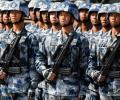
Asked about the continued tensions along the border and whether the PLA troops action was anyway related to the disagreements with the Indian government's plan to lure business out of China, Chinese Foreign Ministry spokesman Zhao Lijian said both the countries were in diplomatic contact over the face-off between their troops.

At least a couple of Chinese military helicopters were spotted flying close to the un-demarcated Sino-India border in the area after the fierce face-off on May 5 following which a fleet of Sukhoi-30 jets of the Indian Air Force too carried out sorties there, the sources said.

The Chinese military has already completed moving back its troops from the face-off sites in Galwan Valley, Gogra and Hot Springs in line with the first phase of the disengagement process from the friction points on the LAC in eastern Ladakh, sources said. The main focus now shifts to Pangong Tso. India has been insisting that China must withdraw its forces from areas between Finger Four and Eight.

'For this kind of informal summit, I think it is better to leave the leaders much time to discuss whatever they would like to discuss'

From United States President Donald Trump and Russian President Vladimir Putin, Modi met them all.

Four Chinese soldiers were killed in the fierce clash with the Indian Army in the Galwan Valley in eastern Ladakh in June last year, the People's Liberation Army (PLA) acknowledged for the first time on Friday.

"CCP's (Chinese Communist Party) territorial aggression is also apparent on its Indian border where China has attempted to seize control of the Line of Actual Control by force," US National Security Advisor Robert O'Brien said in a remark on China early this week in Utah.
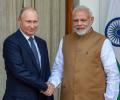
India announced its intention to acquire S-400 'Triumf' surface-to-air missile systems in 2015. The contract worth $5.43 billion was signed during the visit of President Putin to India last year.
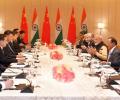
The prime minister started off his remarks at the meeting in Tamil, welcoming China to the talks, which were held right after one-on-one discussions between Modi and Xi at the Taj Fisherman's Cove Hotel.

Pakistani envoys posted in key world capitals, including New Delhi and Beijing, gathered in Islamabad on Monday with top political and military leaders for a meeting that will provide inputs for a proposed foreign policy revamp.
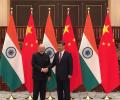
Modi said both India and China need to be "sensitive" to each other's strategic interests and called for specific actions to "prevent growth of negative perception".
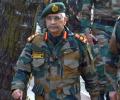
The commanders will also deliberate on the overall situation in Jammu and Kashmir besides delving into issues having national security implications, they said. However, the main focus will be on the situation in eastern Ladakh where Indian and Chinese troops are locked in an eyeball-to-eyeball face-off in Pangong Tso, Galwan Valley, Demchok and Daulat Beg Oldie, the sources said.

Answering questions on the clashes near Naku La Pass in the Sikkim sector which resulted in injuries to both sides, Chinese Foreign Ministry spokesman Zhao Lijian said that the most pressing issue for the world at present is the fight against the coronavirus.

The army chief said that India needs to broaden its understanding of national security and must examine non-traditional threats like pandemics "de-novo" as they have the potential to inflict severe damage on the country. "We need to act and prepare ourselves accordingly."
The cooperation between the two Asian giants is in Russia's interests, said analysts.
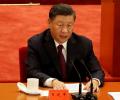
'The world does not care about the tension on our border.' 'India has to emerge as a strong economic power.' 'Respect comes when the world sees a country with a direction and leadership that has a vision,' points out Ramesh Menon.

The onus today is on China, but it also requires a little diplomatic finesse from India, backed by a modernised armed force, argues BJP MP Subramanian Swamy in this excerpt from his new book, Himalayan Challenge: India, China And The Quest For Peace.

The India-China trade is on course to reach the USD 100 billion target by 2015, but New Delhi is concerned over galloping gaps between India's exports and imports from China.

China plans to divert about 200 billion cubic metres of water annually from the Brahmaputra at its highest point, namely the Great Bend, where it turns into India. China's Brahmaputra dam will severely impact India, warns former senior RA&W officer and China expert Jayadeva Ranade.
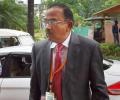
Amid the Sikkim standoff, National Security Advisor Ajit Doval on Thursday held talks with his Chinese Counterpart and State Councillor Yang Jiechi on the sidelines of the BRICS NSAs meeting.

Xi and Modi are scheduled to hold informal summit talks on Friday evening and on Saturday.
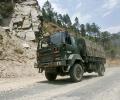
It is learnt that Defence Minister Rajnath Singh has conveyed to top military brass that there was no need for reviewing the implementation of any of the key projects along the Line of Actual Control (LAC) in Ladakh, Sikkim, Uttarakhand or in Arunachal Pradesh in view of the aggressive behaviour by Chinese troops in several sensitive areas.
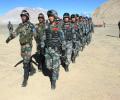
Indian and Chinese troops remained engaged in an eyeball-to-eyeball situation in several disputed areas.
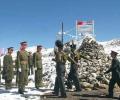
People familiar with the situation in the region said the two sides were engaged in trying to resolve the dispute, but there was no indication of a positive outcome yet as both the armies continued to bolster their positions in disputed areas of Pangong Tso and Galwan Valley and Demchok.

Dispelling the notion that India-China are rivals, Bambawale also said there is no "anti-China mentality" in India.

'It will be a repeated folly to ever think that China will not attack us.'

"Terrorism is an enemy of the basic human rights: of life, peace and prosperity," Swaraj said.

According to official sources, the primary objective of Wei's visit is to deliberate with Indian defence establishment on implementation of decisions taken by Modi and Xi in their informal summit in Wuhan in April.
China said it hoped India would abide by its commitment of not letting Tibetans to engage in anti-China activities and "prudently handle" the issue so as not to "disrupt" the overall bilateral ties. Commenting for the first time on the recent meeting between Prime Minister Manmohan Singh and the Dalai Lama, the Chinese Foreign Ministry spokesperson told PTI.

'From Doklam to Wuhan and the return of the India-China relationship to its previous equilibrium is indeed a major contribution of President Xi and PM Modi. Without any doubt they deserve the kudos for their sagacity and their wisdom,' says Ambassador Gautam Bambawale, India's envoy to China during the Wuhan summit.
Prime Minister Manmohan Singh and his Chinese counterpart Wen Jiabao met on Friday on the sidelines of the Association of Southeast Asian Nations -India and East Asia Summit in Hanoi.
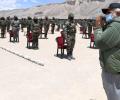
'By not even acknowledging China's occupation of Indian territory Modi signalled to Beijing that he was not prepared to used forceful means to vacate the Chinese occupation, and that his government was reconciled to this loss of territory and accepted the fait accompli engineered by the PLA.'

Noting that India has 'limitless possibilities and countless opportunities', Modi urged the BRICS business leaders to take advantage of them.
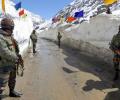
The clear assertion by New Delhi came ahead of a fresh round of Lt General-level talks between the Indian army and the Chinese PLA which government sources said is set to take place within the next two days.
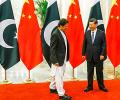
'If a 'two-front war' develops, Iron Brother may only turn out to be a drag on the PLA, since Pakistan is in no position to wage a war with India,' argues Ambassador M K Bhadrakumar.
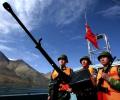
The Chinese side has particularly bolstered its presence in the Galwan Valley, erecting around 100 tents in the last two weeks and bringing in heavy equipment for construction of bunkers, notwithstanding the stiff protest by Indian troops. There have been reports of multiple incidents of transgressions by Chinese troops in several areas in Eastern Ladakh.

Prime Minister Modi will be visiting Mozambique, South Africa, Tanzania and Kenya from July 7 to July 11.

Modi was expected to arrive in Wuhan in the evening on April 26 and join Xi in the informal summit at a picturesque location the next day.

'This novel format of diplomacy -- the informal summit -- will not only facilitate bilateral communication and reduce miscalculations at the very top level of the two governments, but possibly open the space for China and India to speak in one voice on various issues of mutual concern,' note Feng Renjie and Ding Kun Lei
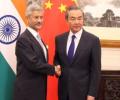
Wang said the two sides should follow the important consensus reached by the leaders of the two countries and strengthen the communication and coordination on the proper handling of the border situation through the existing channels so as to jointly maintain peace and tranquility in the border area, the Chinese foreign ministry said in a statement.
 © 2026 Rediff.com - Investor Information - Advertise with us - Disclaimer - Privacy Policy - Sitemap - Feedback - About us - Terms of use - Grievances